
- Contact MA
- Links
- Mineralogical Almanac
- New Data on Minerals
- Books
- From colleguaes, Vladivostok
- Mineral Shows of 2021
- Gemma, September 25-26
- Museum of Royal Institute of Natural Science, Brussels, Belgium
- MinTrips 2021
- Gemma, October 1-2, 2022
- View Cart
- Русский

“Mineralogical Almanac” is the source of information
for mineral collectors and amateurs around the world
who seek a deeper knowledge of minerals, mineral deposits & localities, collections and more!
Important Dates in April
April 3, Lev Andreevich Suzdaltsev was born. He graduated from the is a mineralogist and collector, living in Chelyabinsk. He graduated from the St.-Petersburg University. During recent 20 years, he gifted several outstanding specimens to the university and other museums. These are epidote and perovskite from the Zelentsovskaya Mine in the South Urals, record pyrochlore crystals from the Tartar massif in Siberia.
April 8, 1765, Vasily Mikhailovich Severgin, a prominent chemist and mineralogist, was born (died 1826). He was a member of the St. Petersburg Academy of Sciences, an author of the first compilation on the minerals of Russia (1809), and one of the founders of the St. Petersburg Mineralogical Society (1817).
April 8, 1960, Victor Ponomarenko was born. He graduathed from the Moscow State Mining Academy. He is a geologist, collector, and connoisseur of mineralogy of Dalnegorsk and Zhezkazghan. He worked on the abandoned pegmatites of Akzhailyau in eastern Kazakhstan where he collected outstanding crystals of pink apatite with alexandrite effect.
April 10, 1927, Alexander Alexandrovich Godovikov was born (died 1995). He is a famous Russian mineralogist. Mineral godovikovite is named in his honor.
April 13, 1923, Anatoly Ivanovich Kuvarzin was born. He is a geologist and a connoisseur of gemstones who worked for many years on the deposits of peuso-optic raw materials and gemstones for the Eksportsamotsvety Expedition. In the 1970s, he was a director of the “Colored Stones†shop in Moscow. He is one of the enthusiastic supporters of the Geopark Project. Together with Godovikov, he worked in the Vernadsky State Geological Museum after its opening in 1988.
April 17, 1834, Nils Gustaf Nordenskiold discovered alexandrite on the birth day of the future Emperor Alexander II. This jewelry variety of chrysoberyl originated from Izumrudnye Mines in the Middle Urals.
April 19, 1765,
April 19, 1957, Vladimir Krikov was born. This geologist and collector graduated from the Moscow State Mining Academy. He worked on the famous deposits of Kazakhstan (Altyn-Tyube, Kara-Oba, Akchatau). The main subject of his outstanding collection is micro-inclusions in quartz. These specimens attracted special attention in the Friends of Mineralogy Club in January-March 2003.
April 24, 1902, Georgy Alexeevich Krutov, a mineralogist and a geologist, was born (died 1989). He was a Professor of the Mineralogy Chair, Moscow University, and specialized in studies of cobalt deposits. Mineral krutovite was named in his honor.
Latest Publications
Mineralogical Almanac, volume 28, issue 2, 2023
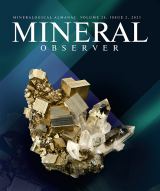
80 pages, 205 illustrations including 104 mineral photos.
This issue the Mineralogical Almanac opens with a paper by the Ural mineralogists Vladimir S. Ponomarev and Yuriy V. Erokhin "Almandine from the Glubochinskoe deposit near Sysert, Central Urals." The column "Outstanding Russian mineralogists" presents a paper by Nadezhda A. Krivolutskaya, Evgenia V. Sidorova and Leonid R. Kolbantsev "There is nothing more practical than a good theory...,” devoted to 120 years of the birth of Mikhail N. Godlevskiy, a remarkable Russian mineralogist and geologist. The photo gallery is dedicated to specimens from Huanggang, China, from the collection of Olga and Dmitry Davydovs. A coverage of an interesting event in life of the the Russian mineralogical community, the exhibition "Mineral. Two Views" at Vernadsky State Geological Museum in Moscow, is given in the paper by Victoria V. Chernenko and Vladislav G. Dyatlov. The issue closes with a paper by Michael B. Leybov, in which he shares his impressions of the 2023 Tucson Mineral Show.
Status: Available
Price: $35.00 (USD)
 Add to shopping cart
Mineralogical Almanac, volume 27, issue 3, 2022
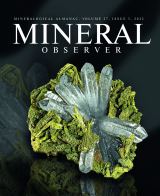
80 pages, 196 illustrations including 103 mineral photos.
This issue of the Mineralogical Almanac is dedicated to memory of Boris Z. Kantor (1930–2022), a devoted friend, prolific author, and continuous editor of the magazine, an outstanding mineral collector, and talented popularizer of mineralogy. His life journey and creative development are described in the article by Igor V. Pekov and Michael B. Leybov. The outstanding Bulgarian mineralogist Mikhail N. Maleev and the colleagues from the United States Prof. John Rakovan, museum curator Carl A. Francis, and renowned mineral collector Alexander G. Schauss share their recollections of Boris Z. Kantor. This issue also includes a paper written in 2022 by Boris Z. Kantor on some morphological types of quartz. Emphasizing the high skill and talent of Boris Z. Kantor as a photographer, we present a gallery of selected photographs of mineral specimens that he took in different years for his publications. This issue is colluded with two papers devoted to interesting mineral localities in Russia. Mikhail V. Tsyganko writes about the Peschanskoe iron deposit in the Northern Urals, and Maria D. Mil'shina and Aleksey Yu. Mil'shin give an account of the Vorobievsky crushed stone quarry in the Tver region.
Status: Available
Price: $35.00 (USD)
Add to shopping cartMineralogical Almanac, volume 28, issue 1, 2023
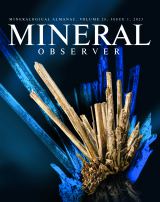
80 pages, 161 illustrations including 92 mineral photos.
This issue of Mineralogical Almanac is traditional in its content. The team of authors – Yuriy V. Erokhin, Vladimir S. Ponomarev, Ivan A. Baksheev, Valeriy V. Grigor'ev, and Anatoliy V . Zakharov has prepared an article on a sensational find of dravite near Ekaterinburg at Central Urals. In our “Travels for the Minerals” section, we publish an article by Mikhail V. Tsyganko, Georgiy A. Petrov, Vladimir A. Popov, and Anatoliy V. Kasatkin about an expedition for staurolite to the Khoza-Tump Ridge in the North Urals. The Tatarstan Natural History Museum and its mineralogical collection are described in the article by Oleg P. Shilovskiy, Oleg N. Lopatin, and Mikhail V. Tsyganko. In the section “Person of the Mineral Community,” we publish an article by Dona Leicht, dedicated to Marie Huizing, the Editor-in-Chief of Rocks & Minerals magazine. As usual, there are reviews on Mineral Shows: Munich Show (September, 2022) and Gemma (December, 2022). Sergey V. Kolisnichenko wrote the notice on new Gumbeika meteorite recently found in the South Urals. Artem S. Borisov wrote the note on a new book for mineral collectors “Rudabánya. Mining-Geology-Minerals” which is illustrated by László Kupi photos from this book. The Stone-carving masterpieces of the State Hermitage Museum are covered by Natalia M. Mavrodina and Elena A. Ol'khovaya in the article “Altai Colored Stone of Kolyvan stonecutters in the Hermitage.”
Status: Available
Price: $35.00 (USD)
Add to shopping cart